
Surface Treatment
Including but not limited to below:
● Passivation
● Zinc Plating
● Gold Plating
● Silver Plating
● Copper Plating
● Bright Nickel Plating
● Electrodes Nickel Plating
● Black Oxide Coating
● Chemical Film Coating
Passivation
The passivate process is designed to remove foreign metals and oils (usually from machining) from the surface of stainless steel. The end finish will not change the dimension of the part nor the overall appearance of the base metal. Passivation purifies the surface of a machined part and therefore improves corrosion resistance.
QQ-P-35C is the Federal standard for passivation.
QQ-P-35 Passivation Types
Type I - Low temperature.
Type II - Medium temperature.
Type III - High temperature.
Type IV - For steels containing large amounts (0.15%) or sulfur or selenium.
Type V - Anodic - For high carbon martensitic (440) steels.
Type VI - Low temperature (optional)
ASTM A967 is the standard specification for chemical passivation treatments for stainless steel parts.
Zinc Plating
The zinc plating process offers several advantages to the metal. Zinc plated characteristics include an increase in corrosion resistance (comparable to cadmium) with an addition increase in resistance when chromates and sealers are used during the process. By zinc plating metal, it prolongs the life of the basis metal improves aesthetic value of the part and serves as a good paint base. Additionally, zinc plating services increase the lubricity and can be used for identification purposes when combined with chromates and dyes.
Things to note:
Corrosion resistance of zinc is comparable to cadmium
Corrosion resistance can be increased with the use of chromates & sealer
ASTM-B-633 QQ-Z-325B Zinc Plating Services
Type I - Without supplementary treatment
Type II - With supplementary chromate treatment
Type III - With supplementary colorless chromate treatment
Type IV - With phosphate conversion treatment
Fe/Zn 25 - SC 4 (very severe)
Fe/Zn 12 - SC 3 (severe)
Fe/Zn 8 - SC 2 (moderate)
Fe/Zn 5 - SC 1 (mild)
Zinc Plating Chromate Colors & Types Offered
Clear (Silver)
Olive Drab
Black
Yellow (Gold)
Red (small quantities)
Green (small quantities)
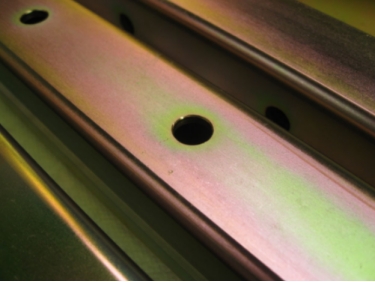
Gold Plating
Other than its aesthetic appearance, gold plating has many useful characteristics. The first being that it provides excellent corrosion and tarnish resistance. Second, gold plating is a great finish if conductivity is a major concern. One of the important characteristics of gold plating is that it has an extremely low contact resistance for electricity. Lastly, gold provides a great finish for solderabilty.
Gold Plating - Types, Grades & Classes
Type I: 99.7% gold minimum (Grades A, B, or C).
Type II: 99.0% gold minimum (Grades B, C, or D).
Type III: 99.9% gold minimum (Grade A only).
Grade A: 90 Knoop maximum.
Grade B: 91-129 Knoop.
Grade C: 130-200 Knoop.
Grade D: 201 Knoop and over.
Class 00: .00002" minimum thickness
Class 0: .00003" minimum thickness
Class 1: .00005" minimum thickness
Class 2: .00010" minimum thickness
Class 3: .00020" minimum thickness
Class 4: .00030" minimum thickness
Class 5: .00050" minimum thickness
Class 6: .00150" minimum thickness
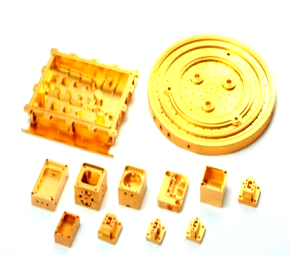
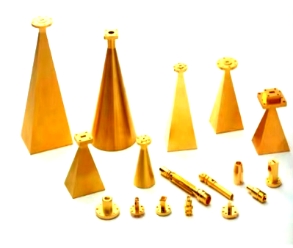
Silver Plating
Silver Plating provides a coating which is matte-white in appearance. This finish provides good corrosion resistance, but also has the tendency to easily tarnish. Though inferior to gold plating, silver plating provides many of the same characteristics at a more economical price. Silver is a great coating for solderabilty of small parts, it also provides a good coating for parts that require low electrical resistance, and lastly, silver provides great lubricity.
QQ-S-365D is the Federal Standard which covers electrolytic silver plating on various metals.
Type I - Matte
Type II - Semi-bright
Type III - Bright
Grade A: Chromate post-treatment to improve tarnish resistance.
Grade B: No supplementary treatment.
ASTM-B-700 covers electrolytic silver plating on various metals.
Type I - 99.9%
Type II - 99.0%
Type III - 98.0%
Grade A: Matte
Grade B: Bright
Grade C: Bright - Polished
Grade D: Semi-bright
Class S: Chromate post-treatment to improve tarnish resistance.
Class N: No supplementary treatment.
Brightness of part can depend greatly on surface finish of base material.
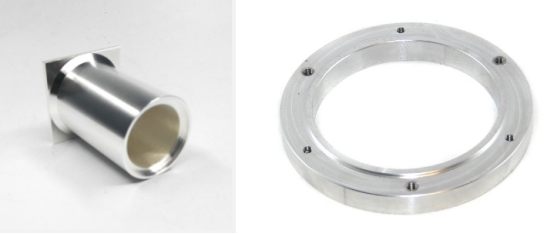
Copper Plating
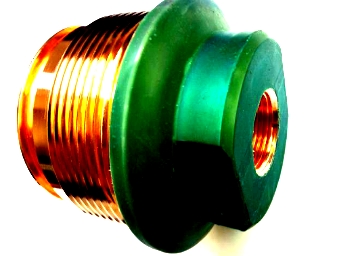
Copper Plating provides a coating which is reddish in appearance. Copper can range from a matte to bright finish which is often depends on the surface brightness of the part.This finish provides good corrosion resistance, but also has the tendency to easily tarnish. Copper is a great coating for solderabilty of small parts, and it also provides an economical finish for parts that require low electrical resistance.
Classes of Copper Plating
Class 0: (Unless otherwise specified .001-.005") For heat treatment stop-off.
Class 1: (.001" minimum thickness) For carburizing and decarburizing shield, also plated through printed circuit boards.
Class 2: (.0005" minimum thickness) As an undercoat for nickel and other plating.
Class 3: (.0002" minimum thickness) To prevent basis metal migration into tin (prevents poisoning of solderability).
Class 4: (.0001" minimum thickness).
Brightness of part can depend greatly on surface finish of base material.
Bright Nickel Plating
Nickel provides:
● Excellent resistance to corrosion
● Strong, durable, and malleable coating
● Versatile finish
● Bright finish
Things to note with Bright Nickel Plating:
Appearance of nickel can vary from dull to very high luster depending on the phosphorous levels in the wash.
QQ-N-290A is the Federal standard for Bright Nickel plating.
Bright Nickel Plating Classes:
Class 1: For corrosion protection. Bright nickel plating shall be applied over an underplating of copper on zinc and zinc based alloys.
Class 2: For engineering applications.
Class A: 0.0016" minimum thickness
Class B: 0.0012" minimum thickness
Class C: 0.0010" minimum thickness
Class D: 0.0008" minimum thickness
Class E: 0.0006" minimum thickness
Class F: 0.0004" minimum thickness
Class G: .0002" minimum thickness
Electroless Nickel Plating
Electroless Nickel - MIL-C-26074B
Electroless Nickel Plating, also known as EN or E/Ni, can be plated over a wide variety of metals including aluminum, titanium, mild steels, stainless steel, hardened steel, copper, brass and zinc die-cast. Electroless nickel plating provides:
● Uniform coating on most complex,and/or Irregular surfaces
● Improves resistance to galling
● Hard, wear resistant surface
Things to Note in Electroless Nickel Plating:
● Electroless Nickel is an auto-catalytic chemical reduction coating requiring no electricity to process.
● The phosphorus content of the bath determines the hardness and corrosion resistance of the coating as well as the matte,
● semi-bright or bright finish.
● With the addition of a baking operation following the plating, hardness of coating is enhanced
Black Oxide Coating
The black oxide coating or plating provides a pleasing aesthetic finish as well as a minimal change surface dimensions, .0005" (5 millionths of an inch). Though the black oxide plating does provide some corrosion protection by itself it is necessary to put a protective oil on this finish to keep it from rusting.
MIL-C-13924 Black Oxide Coating
Class 1: Alkaline oxidizing. For wrought iron, cast and malleable irons, common carbon and low alloy steels.
Class 4: Alkaline oxidizing. For other corrosion resistant steel alloys.
Base Materials that black oxide can be applied to include Carbon Steels, Stainless Steel, Copper and Brass.
Chemical Film Coating
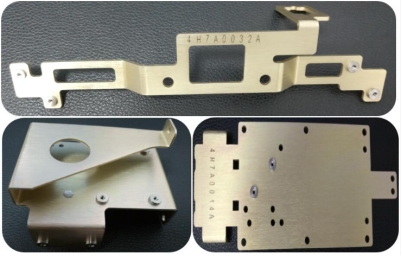
Chemical Film is a chromate conversion coating which may be applied to aluminum parts in order to enhance corrosion protection while still maintaining conductivity (unlike anodizing). Chemical Film may also be used to improve adhesion for future paints and primers. This process may be done in both a clear or a golden finish. The clear finish is near colorless and provides minimal electrical resistance; whereas, the golden finish is much thicker and is mainly used to increase corrosion protection as well as paint adhesion. The typical chemical film coating should provide roughly 168 hours of salt spray per ASTM B 117.
MIL-C-5541
Class 1A: is used as a corrosion preventative film (unpainted) or to prove adhesion of paint finish systems.
Class 3: is used as a corrosion preventative film for electrical and electronic applications where low-resistance contacts are required.
Base Materials that chemical film can be applied to include most alloys of aluminum.
 Address:No. 12 Yinyuan Street, Jiaoyitang, Tangxia Town, Dongguan City, Guangdong, 523723, CN
 Tel:+86 15818526028 +49 1627884014
 Email: