
Plastic Injection Molding Explained
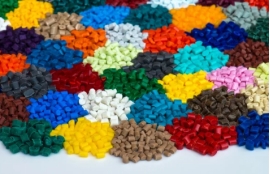
In manufacturing, molding refers to the process of shaping a type of pliable material or liquid by using a rigid matrix or mold. In plastic injection molding, raw polymer resin granules are melted into a liquid and injected into a mold, where the plastic takes the desired shape. Varying levels of heat and pressure may be applied to create the final profile for the end product.
The basic plastic injection molding process consists of the following steps:
1. Plastic resin materials enter a barrel.
2. Heat melts the plastic, which is mixed together.
3. Shot sizes are created, determining the volume of material to be injected into each mold.
4. The mold closes.
5. The melted plastic is injected into the mold cavity.
6. While the material cools and solidifies, the injection molding machine prepares steps 1 to 3 for the next cycle.
7. The mold opens.
8. The part is ejected.
9. The process repeats when the mold closes again.
In today’s ever-evolving world of manufacturing, plastics are being used to make everything from automotive body parts to synthetic human body parts. To create critical components and ensure optimal performance, many manufacturers choose to make use of plastic injection molding.
To suit diverse industry needs, there are several other types of plastic molding available, each offering unique features and benefits. An application’s particular specifications and requirements will determine which type of molding process is best-suited for a specific part.
Below are a few of the most common different styles of plastic molding.
Blow Molding
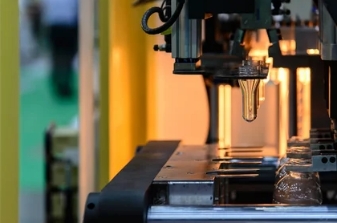
Blow molding machinery in process, The blow molding process follows the same basic steps found in the art of glass blowing. To blow mold a part, the manufacturer inflates a parison — a heated plastic mass, usually in the shape of a tube — with air. The parison inflates until it fills the mold and conforms to its shape. In this way, the plastic is blown into its desired form. Once cooled, the newly formed plastic part is ejected from the mold.
Blow molding is especially useful for economically manufacturing one-piece, hollow objects in large volumes, as the process can quickly create uniform, thin-walled containers — perfect for small objects like bottles, as well as larger ones like storage containers and drums.
Depending on the specific application, manufacturers can use a variety of thermoplastics in blow molding to create a more customized product. Commonly worked materials include low-density polyethylene, high-density polyethylene, polyethylene terephthalate, polypropylene, and polyvinyl chloride.
Extrusion Molding
While other forms of plastic molding use extrusion to insert the plastic resins into the mold, extrusion molding extrudes the melted plastic material directly into the die. This process is unique in that the shape of the die, not the mold, determines the shape of the final product.
Extrusion molding is ideal for manufacturing parts with continuous length and uniform cross-sections. Similar to a plastic injection molding machine, the extrusion molding machine has a screw that turns to feed the plastic resin into the feeder. The molten plastic then moves through a die, creating a long, tubular shape. The shape of the die determines the shape of the plastic tube. Once the extrusion is cooled, it is removed from the machine.
Extrusion molding is well-suited for long, hollow-formed applications, such as tubes, pipes, and straws. Plus, manufacturers can create these parts in many different shapes, including T-sections, U-sections, square sections, I-sections, L-sections, and circular sections.
Injection Molding
Of the various molding processes available, plastic injection molding is considered to be the most versatile, as it can be used to create a variety of parts, ranging in both size and shape. Presses also come in different sizes, based on the pressure they exert and their tonnage.
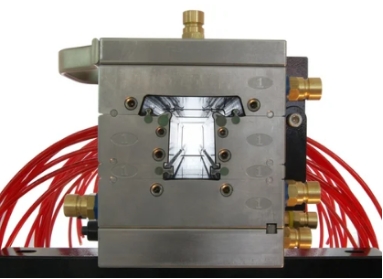
Injection molding basic principles are fairly simple, but the actual process can be quite complex when it comes to maintaining part consistency. The process involves the injection of melted plastic into a mold, which is made of steel. The mold itself has cavities that will form the parts; once injected, the molten plastic fills the cavities and the rest of the mold. Once cooled, the parts are ejected by pins.
Thanks to its excellent versatility, injection molding can be used to create everything from large automotive parts to small, intricate parts used in surgical equipment. Injection molding also allows for a high level of customization, as various plastic resins and additives can be used, allowing designers and engineers to create unique parts to meet highly complex or unusual application needs. And there are some enhancements and techniques available — such as an array of resin and finish options — for manufacturers looking to create even more specialized parts.
Plastic injection molding is a highly reliable solution for producing large numbers of precise, consistent components. It’s also more efficient and cost-effective than other molding styles, in that it produces much less waste. As a result, injection molding is most often used for the manufacture of high-quality parts in high volumes.
 Address:No. 12 Yinyuan Street, Jiaoyitang, Tangxia Town, Dongguan City, Guangdong, 523723, CN
 Tel:+86 15818526028 +49 1627884014
 Email: