
Manufacturing Applications of Automation
One of the most important application areas for automation technology is manufacturing. To many people, automation means manufacturing automation. In this section, the types of automation are defined, and examples of automated systems used in manufacturing are described.
Three types of automation in production can be distinguished:
(1) fixed automation,
(2) programmable automation,
(3) flexible automation.
Fixed automation, also known as “hard automation,” refers to an automated production facility in which the sequence of processing operations is fixed by the equipment configuration. In effect, the programmed commands are contained in the machines in the form of cams, gears, wiring, and other hardware that is not easily changed over from one product style to another. This form of automation is characterized by high initial investment and high production rates. It is therefore suitable for products that are made in large volumes. Examples of fixed automation include machining transfer lines found in the automotive industry, automatic assembly machines, and certain chemical processes.
Programmable automation is a form of automation for producing products in batches. The products are made in batch quantities ranging from several dozen to several thousand units at a time. For each new batch, the production equipment must be reprogrammed and changed over to accommodate the new product style. This reprogramming and changeover take time to accomplish, and there is a period of nonproductive time followed by a production run for each new batch. Production rates in programmable automation are generally lower than in fixed automation, because the equipment is designed to facilitate product changeover rather than for product specialization. A numerical-control machine tool is a good example of programmable automation. The program is coded in computer memory for each different product style, and the machine tool is controlled by the computer program. Industrial robots are another example.
Flexible automation is an extension of programmable automation. The disadvantage with programmable automation is the time required to reprogram and change over the production equipment for each batch of new product. This is lost production time, which is expensive. In flexible automation, the variety of products is sufficiently limited so that the changeover of the equipment can be done very quickly and automatically. The reprogramming of the equipment in flexible automation is done off-line; that is, the programming is accomplished at a computer terminal without using the production equipment itself. Accordingly, there is no need to group identical products into batches; instead, a mixture of different products can be produced one right after another.
Automated Production Lines
An automated production line consists of a series of workstations connected by a transfer system to move parts between the stations. This is an example of fixed automation, since these lines are typically set up for long production runs, perhaps making millions of product units and running for several years between changeovers. Each station is designed to perform a specific processing operation, so that the part or product is constructed stepwise as it progresses along the line. A raw work part enters at one end of the line, proceeds through each workstation, and emerges at the other end as a completed product. In the normal operation of the line, there is a work part being processed at each station, so that many parts are being processed simultaneously and a finished part is produced with each cycle of the line. The various operations, part transfers, and other activities taking place on an automated transfer line must all be sequenced and coordinated properly for the line to operate efficiently. Modern automated lines are controlled by programmable logic controllers, which are special computers that facilitate connections with industrial equipment (such as automated production lines) and can perform the kinds of timing and sequencing functions required to operate such equipment.
Numerical Control
As discussed above, numerical control is a form of programmable automation in which a machine is controlled by numbers (and other symbols) that have been coded on punched paper tape or an alternative storage medium. The initial application of numerical control was in the machine tool industry, to control the position of a cutting tool relative to the work part being machined. The NC part program represents the set of machining instructions for the particular part. The coded numbers in the program specify x-y-z coordinates in a Cartesian axis system, defining the various positions of the cutting tool in relation to the work part. By sequencing these positions in the program, the machine tool is directed to accomplish the machining of the part. A position feedback control system is used in most NC machines to verify that the coded instructions have been correctly performed.
Today a small computer is used as the controller in an NC machine tool, and the program is actuated from computer memory rather than punched paper tape. However, initial entry of the program into computer memory is often still accomplished using punched tape. Since this form of numerical control is implemented by computer, it is called computer numerical control, or CNC. Another variation in the implementation of numerical control involves sending part programs over telecommunications lines from a central computer to individual machine tools in the factory, thus eliminating the use of the punched tape altogether. This form of numerical control is called direct numerical control, or DNC.
Many applications of numerical control have been developed since its initial use to control machine tools. Other machines using numerical control include component-insertion machines used in electronics assembly, drafting machines that prepare engineering drawings, coordinate measuring machines that perform accurate inspections of parts, and flame cutting machines and similar devices. In these applications, the term numerical control is not always used explicitly, but the operating principle is the same: coded numerical data are employed to control the position of a tool or workhead relative to some object.
Automated Assembly
Assembly operations have traditionally been performed manually, either at single assembly workstations or on assembly lines with multiple stations. Owing to the high labour content and high cost of manual labour, greater attention has been given in recent years to the use of automation for assembly work. Assembly operations can be automated using production line principles if the quantities are large, the product is small, and the design is simple (e.g., mechanical pencils, pens, and cigarette lighters). For products that do not satisfy these conditions, manual assembly is generally required.
Automated assembly machines have been developed that operate in a manner similar to machining transfer lines, with the difference being that assembly operations, instead of machining, are performed at the workstations. A typical assembly machine consists of several stations, each equipped with a supply of components and a mechanism for delivering the components into position for assembly. A workhead at each station performs the actual attachment of the component. Typical workheads include automatic screwdrivers, staking or riveting machines, welding heads, and other joining devices. A new component is added to the partially completed product at each workstation, thus building up the product gradually as it proceeds through the line. Assembly machines of this type are considered to be examples of fixed automation, because they are generally configured for a particular product made in high volume. Programmable assembly machines are represented by the component-insertion machines employed in the electronics industry, as described above.
Robots in Manufacturing
Today most robots are used in manufacturing operations; the applications can be divided into three categories: (1) material handling, (2) processing operations, and (3) assembly and inspection.
Material-handling applications include material transfer and machine loading and unloading. Material-transfer applications require the robot to move materials or work parts from one location to another. Many of these tasks are relatively simple, requiring robots to pick up parts from one conveyor and place them on another. Other transfer operations are more complex, such as placing parts onto pallets in an arrangement that must be calculated by the robot. Machine loading and unloading operations utilize a robot to load and unload parts at a production machine. This requires the robot to be equipped with a gripper that can grasp parts. Usually the gripper must be designed specifically for the particular part geometry.
In robotic processing operations, the robot manipulates a tool to perform a process on the work part. Examples of such applications include spot welding, continuous arc welding, and spray painting. Spot welding of automobile bodies is one of the most common applications of industrial robots in the United States. The robot positions a spot welder against the automobile panels and frames to complete the assembly of the basic car body. Arc welding is a continuous process in which the robot moves the welding rod along the seam to be welded. Spray painting involves the manipulation of a spray-painting gun over the surface of the object to be coated. Other operations in this category include grinding, polishing, and routing, in which a rotating spindle serves as the robot’s tool.
Flexible Manufacturing Systems
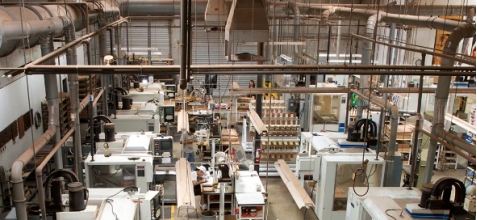
A flexible manufacturing system (FMS) is a form of flexible automation in which several machine tools are linked together by a material-handling system, and all aspects of the system are controlled by a central computer. An FMS is distinguished from an automated production line by its ability to process more than one product style simultaneously. At any moment, each machine in the system may be processing a different part type. An FMS can also cope with changes in product mix and production schedule as demand patterns for the different products made on the system change over time. New product styles can be introduced into production with an FMS, so long as they fall within the range of products that the system is designed to process. This kind of system is therefore ideal when demand for the products is low to medium and there are likely to be changes in demand.
The components of an FMS are (1) processing machines, which are usually CNC machine tools that perform machining operations, although other types of automated workstations such as inspection stations are also possible, (2) a material-handling system, such as a conveyor system, which is capable of delivering work parts to any machine in the FMS, and (3) a central computer system that is responsible for communicating NC part programs to each machine and for coordinating the activities of the machines and the material-handling system. In addition, a fourth component of an FMS is human labour. Although the flexible manufacturing system represents a high level of production automation, people are still needed to manage the system, load and unload parts, change tools, and maintain and repair the equipment.
Computer Process Control
In computer process control, a digital computer is used to direct the operations of a manufacturing process. Although other automated systems are typically controlled by computer, the term computer process control is generally associated with continuous or semicontinuous production operations involving materials such as chemicals, petroleum, foods, and certain basic metals. In these operations the products are typically processed in gas, liquid, or powder form to facilitate flow of the material through the various steps of the production cycle. In addition, these products are usually mass-produced. Because of the ease of handling the product and the large volumes involved, a high level of automation has been accomplished in these industries.
 Address:No. 12 Yinyuan Street, Jiaoyitang, Tangxia Town, Dongguan City, Guangdong, 523723, CN
 Tel:+86 15818526028 +49 1627884014
 Email: